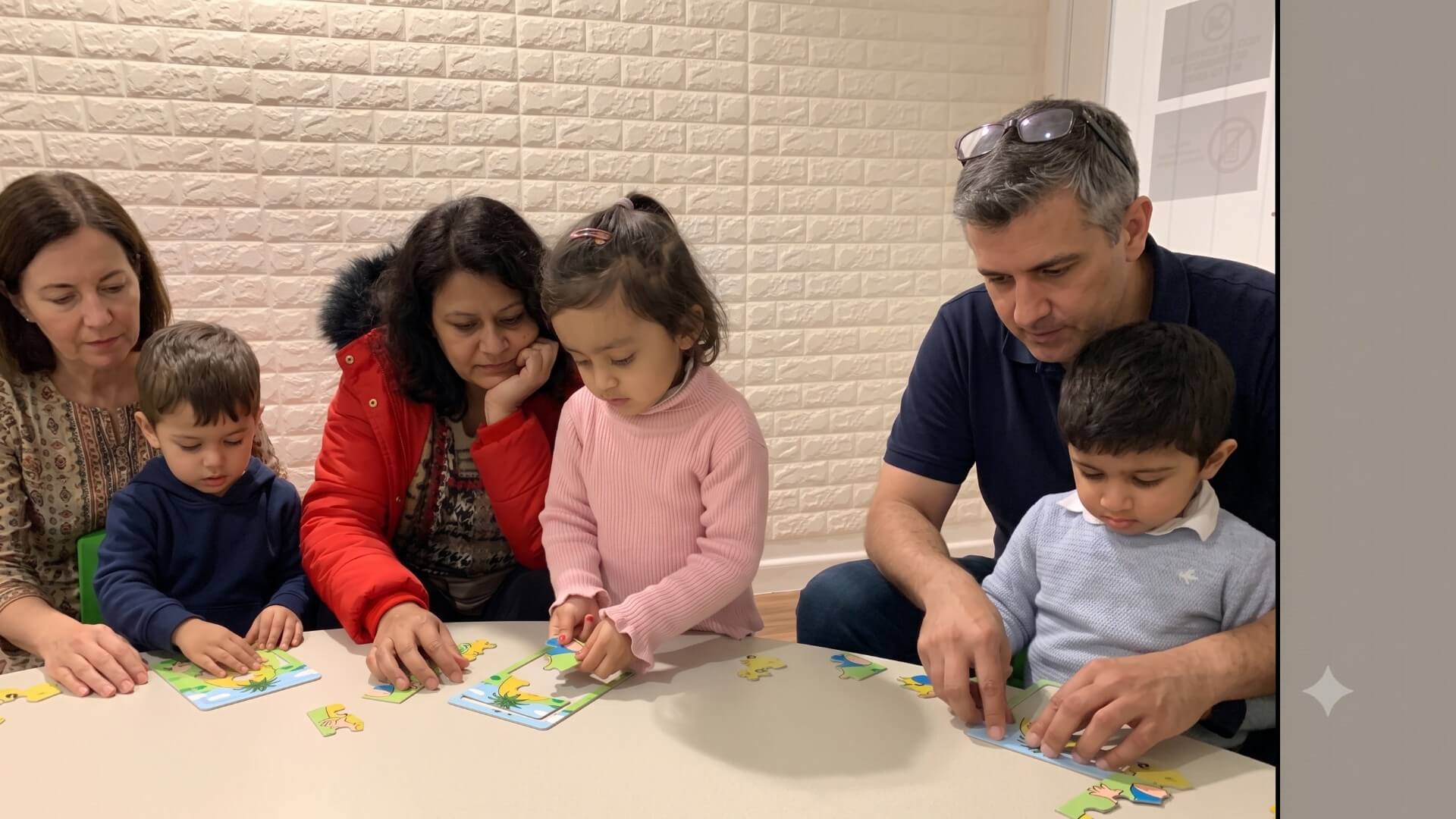
Development19 Jul 2022
Photographic Memory in Young Children
What photographic memory really means in early years cognitive development, what it does not mean, and why it fades if unused.
Read more
From first sounds to full sentences — how language really develops in the early years, and how to give it room.
Children understand far more than they can say, often by a factor of five or more. A quiet eighteen-month-old who follows instructions and points accurately is usually doing exactly what they should be. Output arrives later, and often suddenly.
Not volume of speech directed at a child, but conversational turns — the back and forth. A babbled sound answered with a sentence, a pointed finger answered with a name. Turn-taking is the engine.
Rapid naming work provides clean, high-volume vocabulary input, while listening games sharpen auditory discrimination — the ability to hear the difference between similar sounds, which underpins later reading.
If your child has no words by eighteen months, no two-word phrases by two and a half, or loses language they previously had, speak to your GP or health visitor. Early support is straightforward and effective, and reassurance is worth having.
Curious to see it for yourself? The easiest way to understand a Shichida class is to sit in one. Message our team on WhatsApp to book a trial class and we will help you choose the right stage for your child.
For readers who would like to explore the wider science of early years cognitive development, the following authoritative organisations offer trusted further reading:
Keep Reading
What photographic memory really means in early years cognitive development, what it does not mean, and why it fades if unused.
Read more
The part of the Shichida Method that has nothing to do with memory, and everything to do with the emotional side of early cognitive development.
Read more
Everything you need to know before your first early years cognitive development class — how to book, what to bring, and what happens on the day.
Read more